Meme Coin Trading, A Million-Dollar Playbook
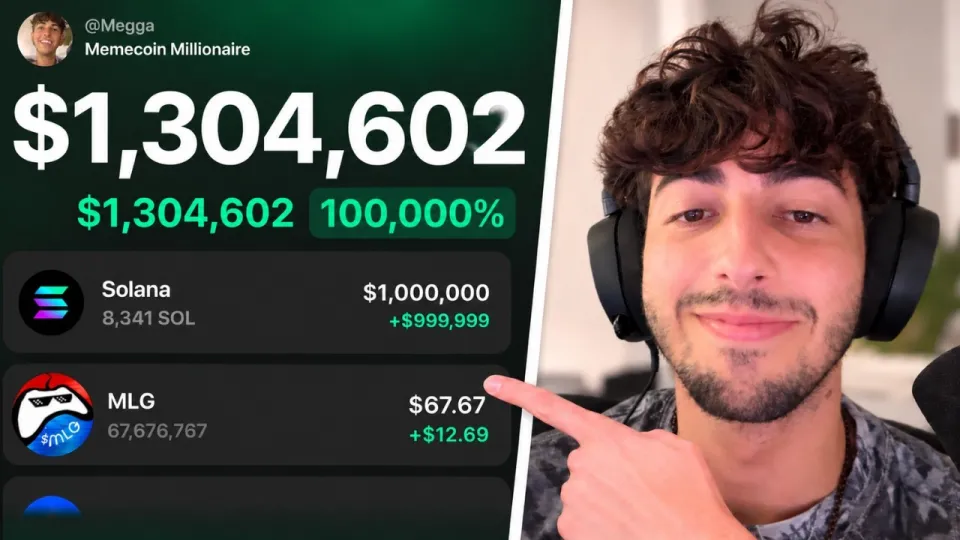
Video: How I Made $1,000,000 Trading Memecoins (FULL BREAKDOWN)
Want articles like this for your own video to promote it on YouTube and Google? Order them through the Telegram bot @sat_sit_bot. The bot writes and publishes the articles itself (with your YouTube video embedded) on popular topical websites (no ads). Free trial — 50 articles.
· based on the channel Megga
Key takeaways
- Megga's breakdown frames a $1,000,000 result as the output of repeated small edges, not one lucky trade.
- Early entry into new meme coin launches is the core skill; most of the profit comes from being right before the crowd arrives.
- Position sizing and hard stop-losses matter more than pick accuracy, because meme coins can drop 80–100% in minutes.
- Trading 9–12 hours a day is the routine described in the video; screen time is the real cost of the strategy.
- Meme coin profits come from other participants' liquidity, so late buyers carry the downside risk.
Meme coin trading is the practice of buying newly launched, community-driven tokens early and selling into the hype cycle before liquidity dries up — and that is exactly the model behind Megga's $1,000,000 result. The breakdown walks through entries, sizing, losses, and the daily grind that produced the number. Anyone who wants the structured version can start with the free course available through this registration link.
Memecoins are not an investment thesis. They are a liquidity game with a narrative attached, and the traders who win treat them as such: fast entries, defined risk, and no emotional attachment to a ticker.
What the million-dollar meme coin breakdown actually shows
The headline number is the least useful part of the story; the repeatable process underneath it is the point. Megga's account of the run is built on volume of attempts rather than a single jackpot: many small positions, a handful of large winners, and a long tail of losses that had to be cut quickly.
Three structural facts drive that outcome:
- Speed beats analysis. New launches are priced by whoever buys first. Being 30 seconds early is worth more than an hour of research on a token that already ran.
- The distribution is skewed. Most attempts return nothing. A small number of positions return 10x–100x, and the entire year's profit lives in those few trades.
- Losses are the operating cost. A trader who cannot take a 40% drawdown on a position without hesitating will not survive long enough to catch the winner.
That is why the video's framing leans so heavily on consistency and process. The result looks like a single event; the input was months of screen time.
How early entries and position sizing create the edge
Entry timing and bet size decide the outcome long before the exit does. In practice, meme coin traders work with a fixed rule set: a defined amount per attempt, a maximum number of open positions, and a hard cap on how much of the portfolio can sit in illiquid tokens at once.
A workable structure looks like this:
- Fixed risk per trade. Decide the maximum loss you accept on a single token before you buy, not after it dumps.
- Small size on new launches. New pairs have thin liquidity; a large order moves the price against you on both entry and exit.
- Scale out, don't hope. Selling part of a position into strength locks in gains that a single exit rarely captures.
- Cut fast. If the thesis was early entry and the token stalls, the thesis is gone. Holding turns a trade into a lottery ticket.
The reason sizing dominates is arithmetic. A trader who risks 2% per attempt survives twenty consecutive losses; one who risks 25% is out of the game after four. Since most meme coin attempts fail, survival is the strategy.
The 9-to-12-hour routine behind the results
The visible trade takes seconds; finding it takes hours. The routine described in the breakdown is essentially full-time screen work: monitoring launch feeds, tracking wallet activity, reading social channels, and watching how a token's holder base and liquidity behave in the first minutes.
What that time actually goes into:
- Scanning new pairs across launchpads and decentralized exchanges as they appear.
- Checking contract and liquidity basics — mint authority, holder concentration, whether liquidity is locked.
- Watching the tape on tokens already moving to judge whether volume is organic or manufactured.
- Reviewing the day's trades to separate process errors from bad luck.
This is the part most viewers underestimate. The question of what a trader does during those hours is the right one, because the answer determines whether the hours compound into skill or just fatigue. A trader with a full-time job can still participate, but the realistic version is fewer, more selective attempts rather than competing on reaction speed.
Risk, rugs, and where meme coin profits come from
The uncomfortable truth of the niche is that every dollar of profit is somebody else's loss, and the last buyers in a dying token absorb most of it. That is not a moral footnote — it is the mechanism that makes the strategy work, and ignoring it is how traders become the exit liquidity they were trying to front-run.
Practical guardrails:
- Assume the token can go to zero. Treat every position as expendable capital, never as savings.
- Verify before buying. Check whether the deployer can mint more supply, whether top holders control most of the float, and whether liquidity can be pulled.
- Watch wallet connections. Bundled buys from linked wallets are a signal that the launch is engineered, not organic.
- Secure your own setup. Phishing links and drained wallets end more trading careers than bad picks do; separate hot wallets from anything holding real balance.
- Expect the drawdown. A 200x winner followed by a drained wallet and a string of losses is a normal sequence, not a verdict on your ability.
A trader who has just taken a large loss is the worst judge of the next trade. Stepping back to basics — smaller size, fewer positions, stricter rules — is the standard recovery path.
Common questions from traders in the trenches
The questions that come up most often are about scale, networking, and whether the model is even accessible without a full-time commitment. All three have concrete answers.
"How much capital do I need to trade with others?" There is no universal threshold, but a documented track record matters more than the number. A consistent profit-and-loss history, even a modest one, is what gets a trader into group voice chats and shared research channels. Posting results and asking specific questions in public timelines is the usual entry point.
"Can I do this while employed?" Yes, with adjusted expectations. Fewer attempts, longer holding windows on higher-conviction setups, and pre-set alerts instead of constant monitoring. The trade-off is that reaction-speed edges are unavailable, so the focus shifts to research and selectivity.
"How do I know if a narrative will actually run?" You don't, and nobody does. What can be assessed is whether a token has the ingredients — active community, clean contract, rising holder count, and liquidity that supports an exit. Treat each launch as a probability, not a prediction, and size accordingly.
"Why do so many people lose?" Because the strategy requires selling before the crowd does, and the crowd is mostly buying. Late entrants fund early exits. Understanding that asymmetry is the difference between participating with rules and donating capital.
Useful links
- Free course and registration: https://whop.com/checkout/plan_Jfp7BxTu8pWGu/?session=chs_HL1L0oQ9QcTEa3
- Trading platform with low fees: https://trade.padre.gg/rk/megga
- Twitch: http://www.twitch.tv/megga
- TikTok: https://www.tiktok.com/@meggafaze
- Twitter: https://twitter.com/megga
Final thoughts on the meme coin game
The $1,000,000 figure is a useful anchor precisely because it is extreme: it shows what a disciplined, high-volume approach to meme coin trading can produce when the tail outcomes land. The transferable parts are unglamorous — fixed risk per attempt, fast exits, verified contracts, and hours of screen time. The non-transferable part is the sequence of winners, which no one can schedule. Megga's full breakdown is worth watching for the process rather than the number, and the free course linked above is the structured starting point if you want to test the approach with your own rules: start here.
Source: How I Made $1,000,000 Trading Memecoins (FULL BREAKDOWN) · Markdown version
Questions & answers
How much money do you need to start trading meme coins seriously?
There is no fixed minimum, but the practical constraint is position sizing: you need enough capital that a 2–5% risk per trade is meaningful without being crippling. Many traders start with a few hundred to a few thousand dollars and focus on building a track record, which matters more than the balance when joining group chats or networking for shared research.
Is meme coin trading the same as investing in crypto?
No. Meme coins are a liquidity and attention game, not a valuation exercise. There are no cash flows or fundamentals to anchor a price, so outcomes depend on entry timing, holder behavior, and exit discipline. Treating them as long-term investments is how traders end up holding tokens that never recover.
Can you trade meme coins with a full-time job?
Yes, but not by competing on reaction speed. The realistic approach is fewer, higher-conviction attempts, price and volume alerts instead of constant monitoring, and longer holding windows on setups that have already proven demand. The trade-off is fewer opportunities in exchange for a schedule that fits around work.
What is the biggest risk in meme coin trading?
Permanent loss of capital, from two directions: the token going to zero, and your wallet being compromised by phishing or malicious approvals. Contract checks, separate hot wallets, and strict per-trade risk limits address both. A single large loss also creates the psychological risk of revenge trading, which is often what turns one bad day into a bad month.